Kitchen cabinets are one of the biggest features in a home. When they look dated, yellowed, worn, or too dark, the whole kitchen can feel older than it really is.
The good news is that many kitchens do not need to be fully replaced. If the cabinet boxes are solid, the layout works, and the doors are in good condition, professional cabinet refinishing can completely change the look of the kitchen at a much lower cost than replacement.
At Ottawa Pro Painting, we provide kitchen cabinet painting and cabinet refinishing in Ottawa using a professional prep and spray finishing process. This is not regular wall paint rolled onto cabinets. Cabinet refinishing requires degreasing, sanding, proper primer, sanding between coats, durable cabinet coatings, and a controlled finish system.
As Ottawa homeowners ourselves, and with over 35 years of family experience in the painting trade, we understand why homeowners want a kitchen that looks fresh without turning the house into a full renovation. Cabinet refinishing is often the right middle ground.
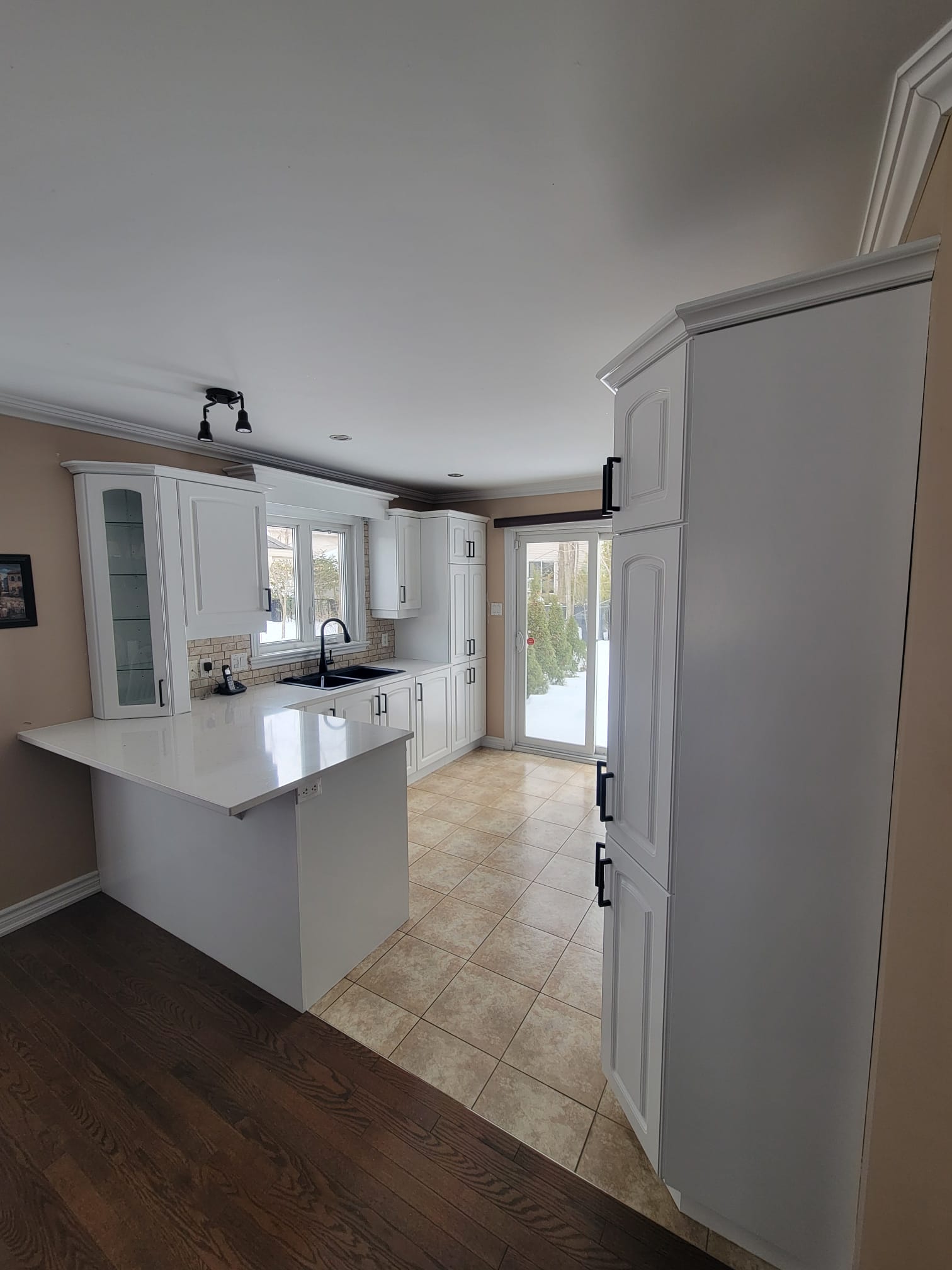
Recently Spray Painted Kitchen by Ottawa Pro Painting
1) When Cabinet Refinishing Makes Sense
Cabinet refinishing makes sense when the kitchen layout works and the cabinets are still structurally sound.
This is common in Ottawa homes where the cabinets are solid but the colour feels dated. Oak cabinets may look too orange. Maple cabinets may look yellow. Dark espresso cabinets may make the kitchen feel smaller. White cabinets may be worn, chipped, or tired.
If the doors and drawer fronts are still in good condition, cabinet painting can give the kitchen a completely new look without replacing the entire kitchen.
For many homeowners, professional kitchen cabinet refinishing is one of the best value upgrades before selling, before moving in, or when updating the main floor.
2) When Cabinet Replacement Makes More Sense
Cabinet refinishing is not the right solution for every kitchen.
If the cabinet boxes are damaged, swollen, poorly built, falling apart, or the layout does not work, replacement may be the better option. Painting cabinets will not fix a bad layout, create more storage, or repair cabinets that are structurally failing.
We usually keep this conversation simple with homeowners. If the cabinets are solid and the main issue is colour, refinishing is worth considering. If the cabinets are damaged or the kitchen needs a full redesign, replacement may make more sense.
At Ottawa Pro Painting, our focus is cabinet refinishing, cabinet painting, and spray finishing. We do not try to make refinishing sound like the answer for every kitchen.
3) Cabinet Refinishing vs. Full Replacement Cost
Full kitchen cabinet replacement can easily become a major renovation.
Once cabinets are removed, other costs often follow. Countertops, backsplash, plumbing, electrical, flooring, and installation can all add to the final price.
Cabinet refinishing is usually much less disruptive because the existing cabinet boxes stay in place. The doors and drawer fronts are removed, prepared, sprayed, and reinstalled. The cabinet boxes are finished in the home.
For many Ottawa homeowners, this gives the kitchen a major visual update without the cost, timeline, and mess of a full kitchen renovation.
4) Typical Cabinet Refinishing Cost in Ottawa
Cabinet refinishing cost in Ottawa depends on the size of the kitchen, number of doors and drawer fronts, cabinet condition, coating system, colour change, and how the cabinet boxes are finished in the home.
As a general guide, a small kitchen may range from about $3,000 to $4,500.
A medium kitchen may range from about $4,500 to $6,500.
A larger kitchen may range from about $6,500 to $9,500 or more.
These ranges usually include shop sprayed doors and drawer fronts, cabinet box finishing in the home, degreasing, sanding, primer, sanding between coats, and two finish coats.
Costs can increase if the kitchen has many doors and drawers, an island, exposed end panels, crown moulding, heavy grease, detailed profiles, oak grain, peeling thermofoil, damaged doors, or sprayed cabinet boxes inside the home.
A proper cabinet painting estimate should always be based on the actual kitchen, not just the square footage of the room.
5) What Makes Cabinet Refinishing Different From Regular Painting
Kitchen cabinets take more abuse than walls.
Cabinet doors and drawers are touched every day. They are exposed to cooking grease, moisture, cleaning products, fingerprints, food residue, and constant opening and closing.
That is why regular wall paint is not the right product for kitchen cabinet painting.
A proper cabinet refinishing system needs strong adhesion, a smooth finish, and better durability than standard interior paint. The process matters just as much as the product.
If cabinets are not cleaned, sanded, primed, and coated properly, the finish can peel, chip, feel rough, or fail around high touch areas.
6) The Products We Use for Cabinet Refinishing
At Ottawa Pro Painting, we use professional water based cabinet coating systems such as Envirolak and Renner.
These products are designed for cabinetry, millwork, furniture, and interior wood finishing. They are not standard wall paints. When used properly as part of a full system, they can create a smooth, durable cabinet finish with strong adhesion and good resistance to daily use.
We like these systems because they are water based, low odour compared to many older solvent systems, and built for the type of finish homeowners expect on kitchen cabinets.
The coating is only one part of the result. The prep, primer, sanding, spray technique, coating thickness, dry time, and cure time all matter.
7) Our Cabinet Refinishing Process
Our cabinet refinishing process starts with removing and labelling the cabinet doors and drawer fronts.
The doors and drawer fronts are taken to be sprayed in a shop setting. This allows for a smoother, more controlled finish than trying to finish everything in the kitchen.
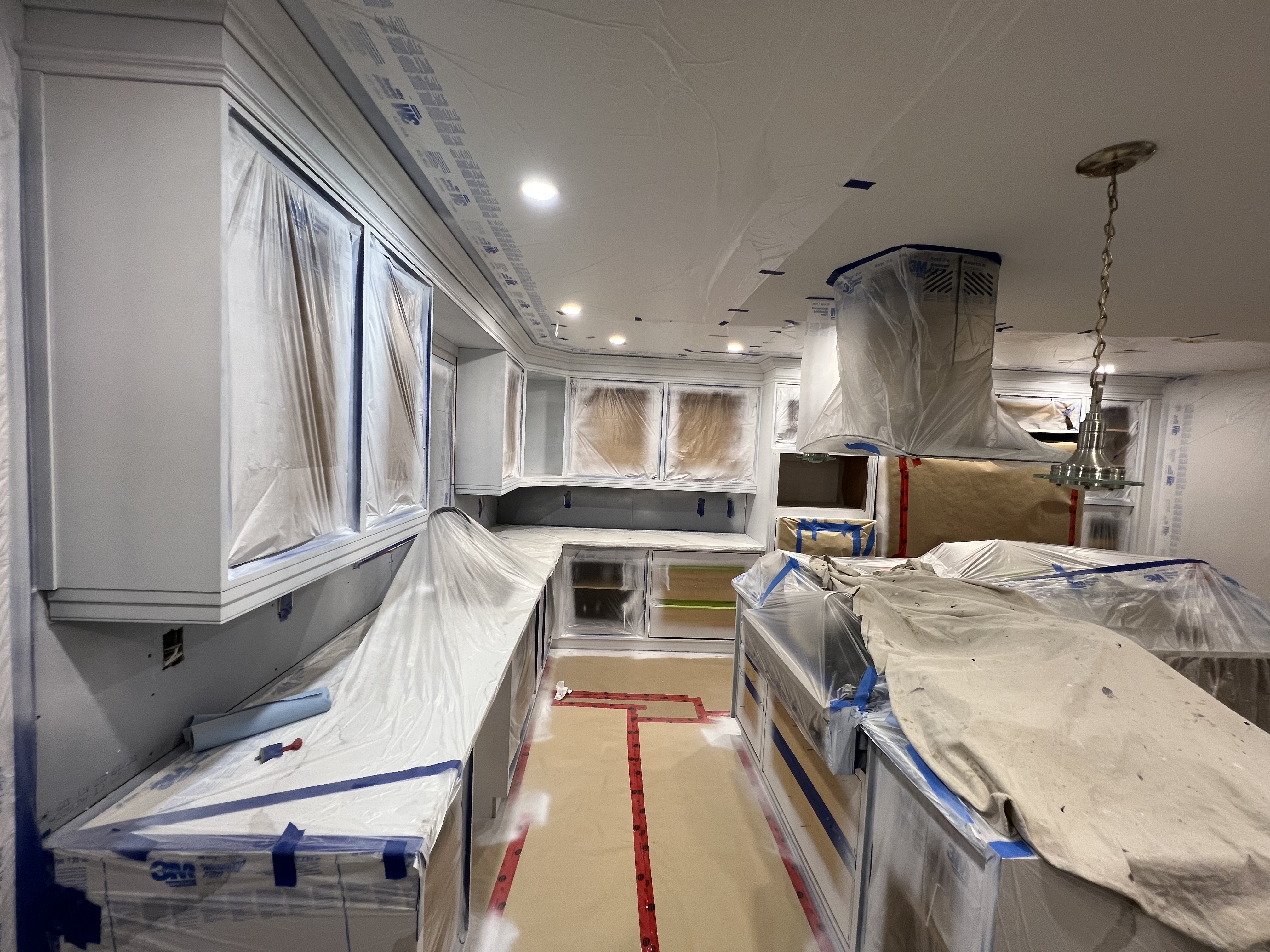
The cabinet boxes stay in the home. Depending on the client’s comfort level, budget, and desired finish, the boxes can be carefully cut and rolled, or they can be sprayed in place.
Spraying the boxes in the home gives the smoothest finish, but it requires more masking, protection, setup, ventilation planning, and time. Cutting and rolling the boxes can be more budget friendly and less disruptive, while still looking very good when done carefully.
We explain both options clearly before the project starts.
8) Cleaning and Degreasing
Degreasing is one of the most important steps in cabinet refinishing.
Kitchen cabinets collect grease, oils from hands, cooking residue, food splatter, and cleaning product buildup. This is especially common around handles, garbage pullouts, sink cabinets, stove areas, and high touch drawers.
Even cabinets that look clean can have contamination on the surface.
If grease is not removed properly, primer and coating may not bond well. That can lead to peeling, poor adhesion, fish eyes, or an uneven finish.
Before sanding or priming, the cabinets need to be thoroughly cleaned and degreased.
9) Sanding Before Primer
After cleaning, the cabinets are sanded.
Sanding helps dull the existing finish, smooth imperfections, and create a better surface for primer to bond to.
The goal is not always to sand the cabinet down to bare wood. In most cabinet refinishing projects, the goal is to degloss and prepare the surface properly.
Detailed cabinet doors require careful sanding around edges, profiles, panels, rails, and stiles. Flat doors need even sanding so scratches do not show through the final finish.
Good sanding is one of the main differences between a quick cabinet repaint and professional cabinet refinishing.
10) Primer, Sanding, and Finish Coats
Primer is the foundation of the cabinet finish.
A proper cabinet primer helps with adhesion, sealing, colour uniformity, and stain blocking. It also helps build a smoother surface before the finish coats are applied.
After primer, the surface is sanded again. This removes roughness, dust, grain raise, and small imperfections. In many cabinet refinishing projects, a second coat of primer may be used for better build and coverage, especially with darker cabinets, oak cabinets, MDF, or colour changes to white.
After the primer system is complete, two finish coats are applied.
This process is what gives the cabinets a cleaner, smoother, more professional finish.
11) Why We Spray Doors and Drawers in Shop
The doors and drawer fronts are the most visible parts of the kitchen.
They are also the surfaces people touch the most. That is why we spray them in a shop setting whenever possible.
Shop spraying gives better control over layout, coating application, drying, handling, and final appearance. It also helps reduce disruption inside the home.
A good spray finish is controlled. It is not just applying paint quickly. The coating needs to be applied evenly, at the right thickness, with proper dry time between coats.
This is how cabinet doors and drawers get a smoother finish that looks closer to factory applied.
12) What About Oak Cabinets and Wood Grain?
Oak cabinets can be refinished, but homeowners should understand the grain.
Oak has an open grain pattern. Even after sanding, priming, and spraying, some grain may still show through the painted finish unless extra grain filling is completed.
Some homeowners like the painted oak look. Others want a smoother modern finish.
If the goal is to make oak look closer to smooth MDF cabinet doors, extra grain filling and sanding may be required. This adds time and cost.
This is something we discuss before starting so expectations are clear.
13) What About Thermofoil Cabinets?
Thermofoil cabinets are common in Ottawa kitchens, and they need to be handled properly.
Thermofoil is a thin vinyl like wrap over MDF cabinet doors. Over time, it can peel, bubble, crack, or lift, especially near heat, moisture, sink areas, dishwashers, ovens, and high use doors.
For our cabinet refinishing process, we remove the thermofoil from the doors and finish the MDF underneath. We do not paint over loose thermofoil or rely on the old wrap to hold the new finish. If the thermofoil is already failing, painting over it is not a proper long term solution.
Once the thermofoil is removed, the MDF needs to be prepared correctly. That means cleaning, sanding, sealing, priming, sanding between coats, and applying a proper cabinet coating system. MDF can absorb coating differently than wood, so the primer and prep process are very important.
When done properly, peeling thermofoil doors can often be refinished and given a clean, modern painted cabinet finish. If a door is badly damaged, swollen, warped, or the MDF is failing, replacement of that specific door may be the better option.
For thermofoil cabinet painting in Ottawa, the key is to remove the failing surface first and build the new finish on a properly prepared base.
14) How Durable Are Refinished Cabinets?
A professional cabinet refinishing system can be very durable, but it is not indestructible.
Cabinets are high use surfaces. They can still chip if hit with a sharp object, scraped aggressively, slammed, or cleaned with harsh chemicals.
The goal is to use a proper cabinet coating system, prepare the surface correctly, allow proper cure time, and treat the cabinets like a finished surface.
Water based cabinet coatings from brands like Envirolak and Renner can perform very well when used correctly. The durability comes from the full system: cleaning, sanding, primer, sanding between coats, finish coats, proper application, and cure time.
That is why professional cabinet refinishing is not just about changing the colour. It is about building a coating system that can handle real kitchen use.
15) How Long Cabinet Refinishing Takes
Most cabinet refinishing projects take about one to two weeks depending on the kitchen size, number of doors and drawers, prep requirements, spraying schedule, in house work, and cure time.
The doors and drawer fronts are removed and sprayed off site. The cabinet boxes are completed in the home. During the project, the kitchen may be partially usable at times, but there will be some disruption.
If the cabinet boxes are sprayed in the home, the setup is more involved. More masking, protection, and ventilation planning are required.
A professional cabinet refinishing company should explain the schedule clearly before work starts.
16) How to Care for Refinished Cabinets
Cabinet coatings dry before they fully cure.
During the early cure period, the cabinets should be used gently. Avoid aggressive cleaning, slamming doors, scraping the surface, or using harsh chemicals.
After curing, clean the cabinets with mild soap and water or a gentle cleaner suitable for painted surfaces. Avoid abrasive pads, strong degreasers, and aggressive scrubbing.
High touch areas around handles, garbage pullouts, sink cabinets, and stove areas should be cleaned regularly but gently.
A refinished cabinet is durable, but it should still be treated with care.
17) Common Cabinet Painting Mistakes
The biggest cabinet painting mistake is treating cabinets like walls.
Skipping degreasing, skipping sanding, using regular wall paint, using the wrong primer, rushing dry time, applying coats too heavy, painting over peeling thermofoil, or reinstalling doors too soon can all lead to problems.
Another mistake is hiring based only on the lowest price. Cabinet refinishing is labour intensive because every step matters.
A cheaper cabinet painting quote may skip cleaning, sanding, primer, shop spraying, sanding between coats, or proper cabinet coatings. That is not the same project.
For kitchen cabinet painting in Ottawa, the process is what protects the finish.
18) What Should Be Included in a Cabinet Refinishing Estimate?
A proper cabinet refinishing estimate should explain what is included.
It should identify the number of doors and drawer fronts, whether the doors and drawers are sprayed in shop, how the cabinet boxes will be finished in the home, what preparation is included, what coating system is being used, and whether repairs or special prep are included.
It should also explain what is not included. New doors, new hardware, hinge upgrades, major cabinet repairs, grain filling, thermofoil removal, and layout changes should not be assumed unless they are clearly stated.
A clear estimate helps homeowners compare cabinet painting companies in Ottawa properly.
19) Is Cabinet Refinishing Worth It?
Cabinet refinishing is worth it when the kitchen is solid and the main issue is the finish.
If the layout works, the cabinet boxes are in good condition, and the doors are worth saving, refinishing can give the kitchen a major transformation without a full renovation.
It is especially valuable for homeowners who want to update their kitchen before selling, refresh a dated main floor, modernize oak cabinets, brighten a dark kitchen, or get a new cabinet colour without replacing everything.
For many Ottawa homes, cabinet refinishing is one of the most practical ways to make the kitchen feel newer.
Professional Kitchen Cabinet Painting in Ottawa
Ready to Refinish Your Kitchen Cabinets?
If you are thinking about cabinet refinishing, kitchen cabinet painting, or cabinet spraying in Ottawa, Ottawa Pro Painting can help.
We provide professional cabinet refinishing in Ottawa, including cabinet door spraying, drawer front refinishing, cabinet box painting, cabinet box spraying, cabinet prep, sanding, priming, and durable cabinet coating systems.
As a professional painting company in Ottawa, we focus on detailed preparation, shop sprayed doors and drawers, clean in home cabinet box finishing, quality coatings, and a smooth final finish.
Whether you want to paint oak cabinets, update dark cabinets, refinish white cabinets, refresh a condo kitchen, repaint a rental kitchen, or modernize your kitchen without replacing everything, Ottawa Pro Painting can help you choose the right approach.